Back Office › Analytics › Performance › Turn Times shows how long parties really stay at a table. Reservations promise a table for a set time; this page lets you set those times from your own numbers. It opens on the last 28 business days, ending yesterday.
The toolbar
- From / To — the business days to include. Turn times need plenty of seatings to be reliable, so the quick buttons here are 28d, 13w and 26w.
- Room picker — shown when your seating chart has more than one room; pick one to see only its tables, or All Rooms.
- Schedule — emails the report on a schedule, for the room you picked. See Emailing the performance reports on a schedule.
- PDF — preview, download or email the report. CSV downloads the grid, the turn lengths and each table’s average turn. Both are greyed out when the range has no measured seatings. The file’s section titles, column headings, day names and Yes/No values are in the language the Back Office is shown in; numbers use a dot for decimals with no thousands separator, and dates are written year-month-day, so a spreadsheet reads them the same in any language.
- The refresh button loads the figures again.
The numbers at the top
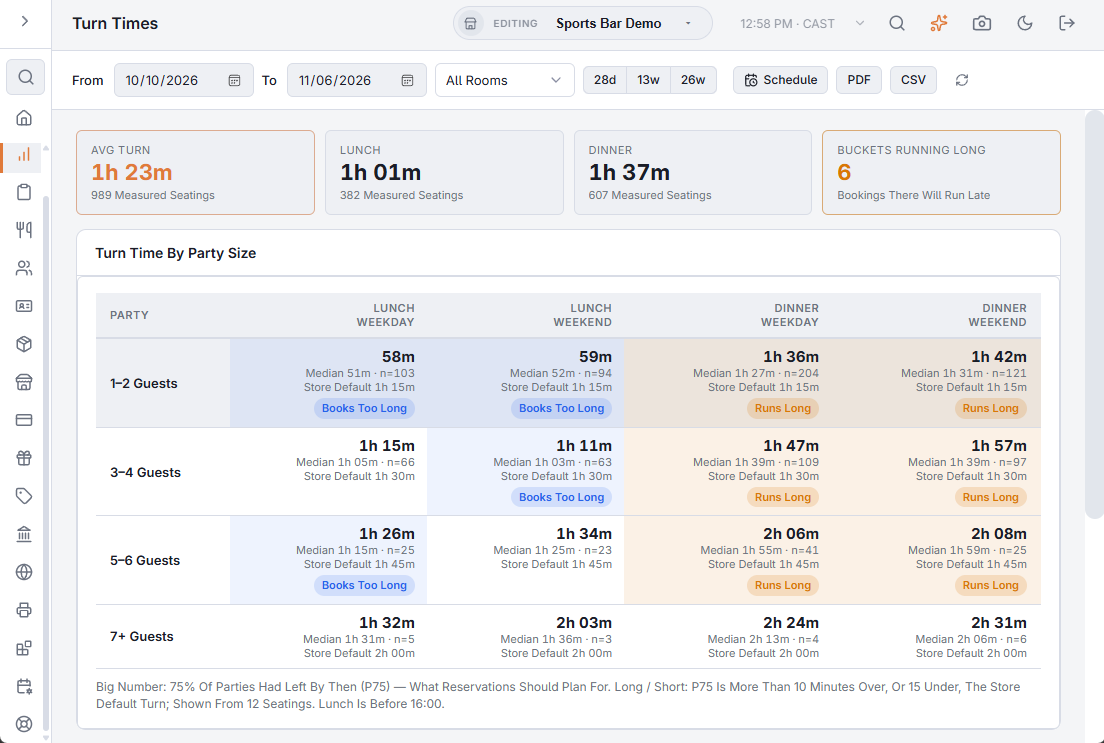
- Avg Turn — the average turn over all measured seatings, with how many were measured.
- Lunch and Dinner — the same for each part of the day.
- Buckets Running Long — how many cells of the grid below carry Runs Long: bookings there will run late.
The grid
In Turn Time By Party Size, rows are party sizes (1–2, 3–4, 5–6, 7+ guests) and columns are lunch and dinner on weekdays and weekends — the same buckets reservations use. Lunch is any seating before 16:00; the weekend is Saturday and Sunday. In each cell:
- The big number is the P75: 75% of parties had left by then. It is what a booking should plan for — plan on the average and half your bookings run late.
- Median — the middle party; n — how many seatings were measured. Hover the cell for the average too.
- Store Default — the store’s turn time set for that party size and part of the day under Turn Times on Back Office › Store Setup › Reservations, or the built-in figure when none is set: 75, 90, 105 and 120 minutes for 1–2, 3–4, 5–6 and 7+ guests.
- Runs Long — the P75 is more than 10 minutes over the store default turn: bookings in that bucket will run into the next one. Books Too Long — more than 15 minutes under: you hold tables back that could take another party.
Flags only appear once a bucket has at least 12 measured seatings.
How long tables are held, and the slowest tables
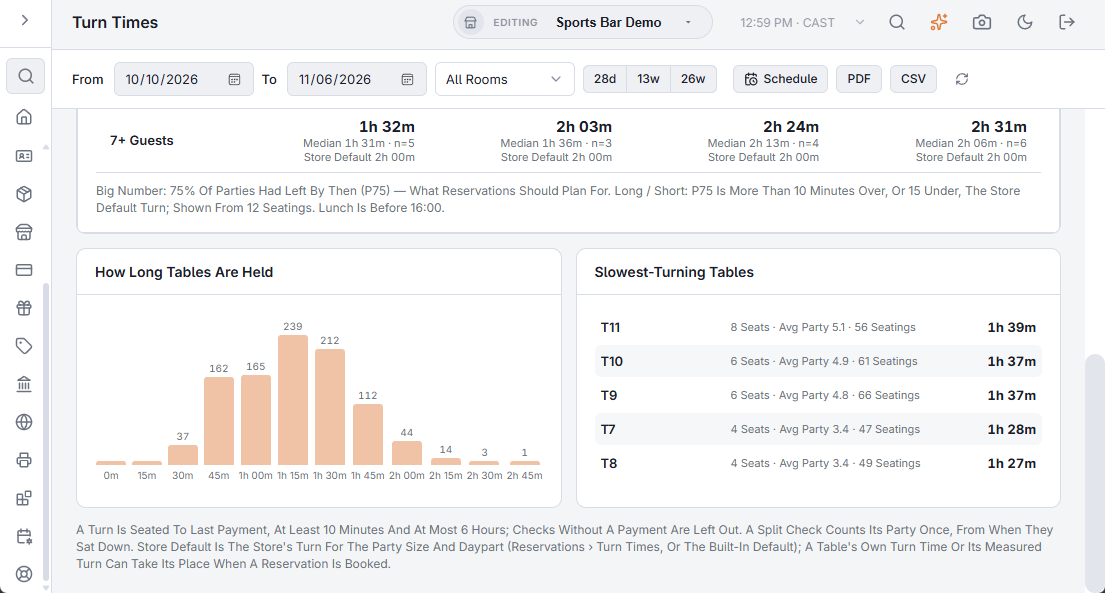
How Long Tables Are Held shows how many seatings lasted each 15-minute band, up to 4 hours and more; a long tail on the right is the campers. Slowest-Turning Tables lists the five tables with the longest average turn (at least five seatings), with their seats, average party and seatings — often the booths and the window tables.
What to do about it
- Where a bucket runs long, raise its turn time in your reservation settings, or work on the slow steps (see Server Pace Report).
- Where it books too long, lower the turn time to offer more booking slots.
Combined tables
Parties that held more than one table are left out of turn times, here and in the measured turns that reservations use, so one large party does not change what a single table normally takes. Large parties keep the store’s turn time for their size. When the period has any, a Combined Tables note above the footnote gives their number. See Combining tables for a large party.