On a night with cashiers on drawers and banked servers on the floor, “where is the cash?” has several answers at once. This topic is the map: every amount the store takes is in one place at a time, and every hand-over is a recorded event.
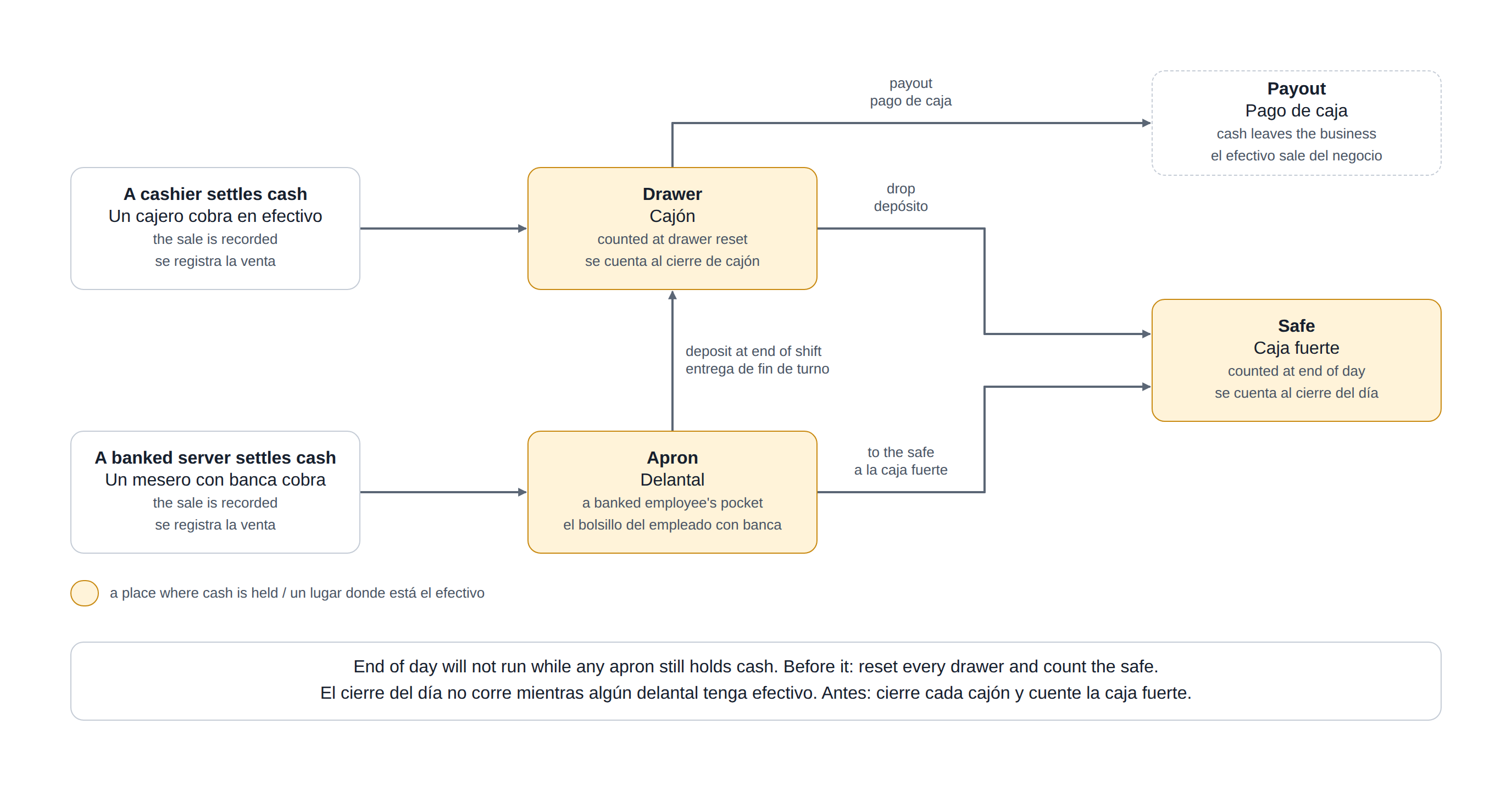
The places cash can be
- A drawer — tracked by the drawer’s expected cash: opening cash in, cash payments in, employee deposits in, change out, drops out, payouts out, and the deposits an End Shift there applied out. Counts check it.
- With a banked employee — tracked by their liability: the orders they banked, less their deposits.
- The safe — receives the cash drops recorded from the drawers, and keeps them on the Safe screen until a bank deposit is recorded. See The Safe and bank deposits.
The events that move cash
- A cashier takes a cash payment → the drawer’s expected cash rises, because the cash went into the till.
- A server or driver banks an order → no drawer changes. Their liability rises instead: the cash is with them.
- Cash drop → the drawer’s expected cash falls; the cash is in the safe. See Cash drops to the safe.
- Payout → the drawer’s expected cash falls; the expense is recorded. See Cash paid-out and reasons.
- Deposit → a banked employee hands cash into the drawer in use; the drawer’s expected cash rises and their liability falls by the amount.
- End Shift → every order they banked is settled as cash at the active drawer and End Shift takes their deposits off that drawer, so its expected cash rises by the banked total less the deposits: what they hand over now. The deposits stay in the drawer that took them. Their liability is now zero. See Employee banking and deposits.
- Drawer reset → the drawer is counted against everything above, and the over or short is recorded. See Drawer reset at end of shift.
A worked night — one cashier, two servers
Drawer 1 opens with 200.00. The cashier takes 500.00 in cash: the drawer expects 700.00. Maria (banked) banks orders worth 400.00 and Tom (banked) orders worth 250.00; the drawer does not change. Mid-shift the drawer passes its drop level and 400.00 goes to the safe: the drawer expects 300.00.
Maria deposits 150.00 into Drawer 1: her liability is 250.00, and the drawer holds and expects 450.00. At Maria’s End Shift she hands over the other 250.00; her orders settle as 400.00 cash and End Shift takes her 150.00 deposit off that drawer: the drawer expects 700.00 and holds 700.00. (Had her End Shift run at another drawer, Drawer 1 would still expect 450.00 and the other drawer would expect 250.00 more.) Tom’s End Shift at the same drawer adds 250.00: the drawer expects 950.00.
The reset counts 950.00 in Drawer 1, and the safe holds the 400.00 drop: 1,350.00 = 200.00 opening + 500.00 + 400.00 + 250.00.
With ten servers
Nothing changes except the number of liability lines. Shift Banking at the register, and the Employee Banking page in Back Office (The Employee Banking dashboard), list everyone’s live position. Each End Shift closes one line and leaves a record in the End Shift Log.
Reading problems off the map
- A drawer counts short → a drawer event is missing or wrong: change given wrongly, a till opened by key, a payout not recorded. Banked cash does not touch the drawer until a deposit or End Shift.
- End Shift ran at a different drawer from the one that took the deposits → nothing to fix. The drawer that took the deposits expects them, and the End Shift drawer expects only the cash handed over. Each drawer’s reset closes its own part, in either order.
- Before End of Day → run End Shift for every banked employee, reset the drawers, and check the cash in the safe against In The Safe on the Safe screen. End of Day refuses to run while banked orders are outstanding.
Two more events
- Paid In → cash is added to a drawer outside a sale, such as change from the safe or the bank; the drawer’s expected cash rises. See Cash paid-out and reasons.
- Bank deposit → cash drops leave the safe for the bank. Recorded on the Safe screen, it takes them off In The Safe; no drawer changes.